AI Invoice Processing and AP Automation
Accounts payable teams spend most of their time on data entry and exception handling that AI handles better and faster. We build end-to-end invoice automation that cuts AP cost per invoice while improving accuracy and audit readiness.
The Challenge
At a typical $500M distributor, AP clerks spend 10-14 hours a week on 3-way matching between the ERP, a separate vendor portal, and an Outlook inbox where suppliers still email PDFs. Invoices arrive in 40+ formats across hundreds of vendors. Each one needs header and line extraction, PO match, tax validation, GL coding, and approval routing. The team rejects 6-8% of invoices for discrepancies that are usually just vendor SKU-naming variances or unit-of-measure mismatches. Cost sits at $10-25 per invoice, and 20-30% of early-pay discounts are missed because the cycle is too slow. Month-end is worse. A contract rate of 3-5% error rate on keyed invoices is the baseline most AP directors accept, because the work is too repetitive to stay sharp on.
Our Approach
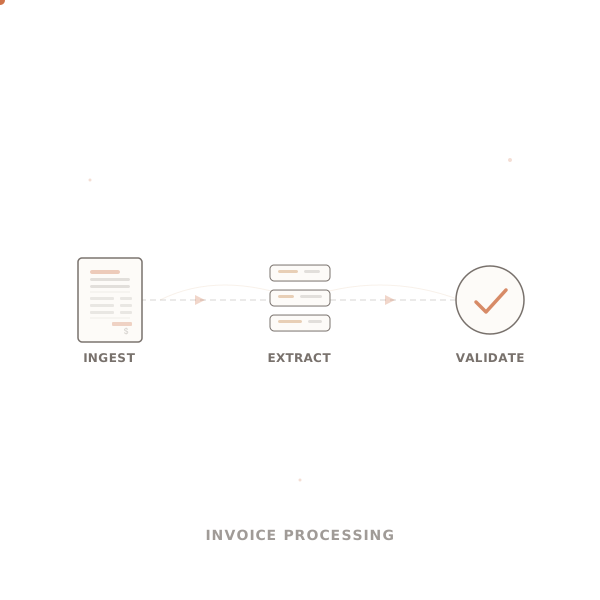
A Claude Sonnet 4.5 agent reads incoming invoices from an SFTP drop, an O365 shared mailbox, and EDI feeds, then extracts header and line items via structured output. It queries SAP S/4HANA for matching POs using the vendor ID and PO reference, applies your tolerance rules (price, quantity, unit of measure), suggests GL codes from historical coding patterns stored in a Postgres feature store, and posts approved entries via SAP OData APIs. Exceptions route to a review UI that mirrors an Excel grid, with the failed validations highlighted inline. The agent learns from every reviewer override through a feedback loop that updates vendor-specific extraction prompts and coding rules. Sonnet 4.5 handles vendor-specific layout drift without retraining, which is where rules-based OCR pipelines fail.
How We Do It
Invoice Capture and Data Extraction
The agent monitors an O365 shared mailbox, an SFTP drop, and vendor portal APIs on a 5-minute poll. Attachments flow through Textract for the PDF image layer, then Claude Sonnet 4.5 extracts header fields (vendor, invoice number, dates, totals, tax, PO reference) and line items (description, SKU, quantity, unit price, line total) as structured JSON. Accuracy is validated against a golden set of each top-50 vendor's formats during onboarding. Failure mode: OCR quality drops below 85% confidence on a scanned fax, in which case the invoice routes to manual keying with the raw image attached so nothing stalls silently.
PO Matching and Validation
Extracted data is matched against open POs in SAP using a composite key of vendor ID + PO number, with fallback to fuzzy match on vendor name when the PO number is missing or malformed. 2-way match covers services, 3-way match adds goods receipt verification. Tolerance rules (e.g. 2% price variance, 5% quantity variance up to $500) are configurable per category. Discrepancies surface with specifics: 'Line 3 price variance +4.2%, expected $42.10, got $43.87'. Failure mode: vendor SKU differs from PO SKU (14A-BOF vs 14A-BOE). The agent checks the vendor cross-reference table before flagging.
GL Coding and Cost Allocation
For each line item, the agent queries a Postgres vector index of the last 24 months of coded invoices from that vendor and line description. If it finds 10+ matches with 90%+ coding agreement, it auto-codes with the majority GL account and cost center. Otherwise it suggests the top 3 codes with confidence scores for reviewer pick. New vendors default to a coding queue with the category lead. Failure mode: a vendor switches business lines mid-year and historical coding no longer reflects intent. The system's drift monitor flags when the top coding shifts and routes the next 10 invoices to review.
Approval Routing and ERP Integration
Validated invoices route to approvers from your delegation-of-authority matrix, looked up by cost center, amount band, and vendor category. Approvers receive a Teams card with the invoice PDF, the extracted fields, and one-click approve or reject. On approval, the agent posts to SAP via the A/P invoice OData endpoint, captures the document number, and writes a signed audit entry to an append-only Postgres log. Failure mode: SAP returns a posting error (duplicate invoice, closed period, budget block). The agent catches the response code, routes to AP with the exact SAP error text, and retries once the block is cleared.
What You Get
Where this fits — and where it doesn't
Good fit when
- ✓High-volume, repetitive AP environments with 3,000+ invoices monthly across 100+ vendors, where per-invoice processing cost is a measurable line item and the AP team is understaffed relative to volume.
- ✓Organizations running a mainstream ERP (SAP, Oracle, NetSuite, Dynamics) with documented PO data, clean vendor master records, and APIs already enabled for A/P posting.
- ✓Companies where at least 70% of spend flows through POs, giving the agent a reliable match anchor. Non-PO spend can still route through coding rules but accuracy is lower.
Not a fit when
- ×Vendor master data is a mess. If the vendor file has duplicate records, inconsistent naming, and no PO discipline, the agent will compound the existing chaos rather than fix it. Clean the master first.
- ×Highly custom, hand-keyed invoice formats with freeform descriptions and no PO reference, common in construction progress billing or professional services retainers. These are better suited to a guided intake form than agent extraction.
- ×Organizations with fewer than 500 invoices monthly. The per-invoice cost savings don't cover implementation and the team loses more by context-switching than they gain in automation.
Technology Stack
Integrates with
Industries We Serve
Frequently Asked Questions
What ERP systems do you integrate with for invoice processing?+
How does the system handle invoices from vendors who don't use a standard format?+
What is the straight-through processing rate we should expect?+
How does the agent handle edge cases it hasn't seen before?+
What happens when the agent is wrong?+
How do we audit every decision?+
What's the upfront data prep we need to do?+
How long to production?+
Related reading
AI Agent Development Cost: What You'll Actually Pay in 2026
AI agent development costs range from $20K to $300K+ depending on complexity, integrations, and compliance. Here is a full breakdown of what drives the price.
AI Agents vs RPA in 2026: When to Use Each (and When to Use Both)
RPA works until it doesn't. AI agents handle exceptions natively. Understanding the boundary between the two saves you from expensive mistakes in both directions.
How to Prioritize AI Use Cases: A Scoring Framework
Score and rank AI use cases by business impact, technical feasibility, data readiness, and time to value. Includes a worked example with 5 real use cases.
Ready to build this for your team?
We take this from concept to production deployment. Usually in 3–6 weeks.
Start Your Project →