AI Agents for Research
Research takes time because reading takes time. Literature reviews, competitive analysis, market sizing. Your team reads hundreds of sources to produce a single brief. AI agents do the reading and synthesis so your researchers focus on generating original insights.
The Problem
A typical research team at a strategy firm, pharma company, or investment fund produces 8 to 12 deep briefs a quarter. A single literature review pulls 120 to 300 sources across PubMed, arXiv, Google Scholar, industry reports, patents, SEC filings, and company 10-Ks. A senior researcher spends 60 to 80 hours reading, tagging, and synthesizing, then another 20 hours writing the brief. Competitive intelligence decays fast: a compiled report about a competitor's pipeline is stale within two weeks because a new clinical trial registered or a patent filed in the interim. Market sizing means reconciling conflicting numbers from IDC, Gartner, Frost & Sullivan, and public earnings data, which takes days and still produces a wide range. Internal knowledge is scattered across 40 Confluence spaces, a SharePoint drive, and 18 people's Notion workspaces, so each new project starts from scratch. Your smartest people spend 70% of their time gathering information and 30% thinking about what it means. The economic asymmetry is the opposite of what you'd want.
How AI Agents Solve It
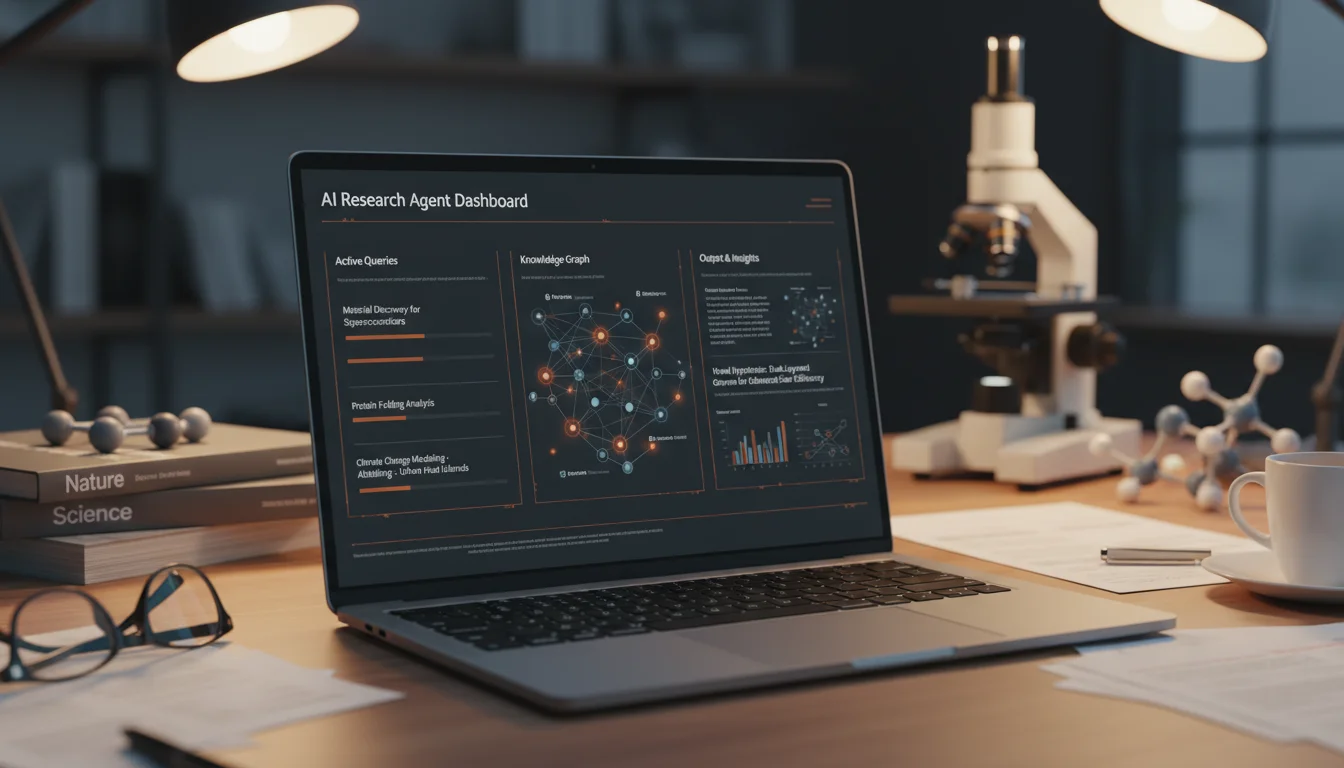
A Claude Sonnet 4.5 agent with retrieval tools over PubMed, arXiv, Google Scholar, SEC EDGAR, patent databases (USPTO and EPO), a Perplexity API wrapper for live web, and a Pinecone index over your internal Confluence, Notion, and SharePoint. The researcher specifies a question and scope (for example, a 4-week narrative literature review on CAR-T safety profiles in solid tumors, Q4 2024 updates). The agent builds a search strategy, pulls 200+ candidate sources, ranks by relevance using semantic similarity plus citation weight, extracts key findings per source with exact quotes and citations, and synthesizes cross-source patterns into a structured brief: executive summary, major themes, contradictions flagged, open questions, source-by-source appendix. Every claim links back to its source with a clickable citation. The researcher validates and adds interpretation. For ongoing competitive intelligence, the agent monitors specified sources daily and posts updates to Slack when anything material appears.
How It Works
Define and Scope
The researcher specifies the question, the relevant sources, any inclusion or exclusion criteria, and the output format. The agent drafts a search strategy covering academic databases (PubMed, arXiv, Google Scholar, SSRN, IEEE Xplore as relevant), industry sources (SEC EDGAR, patent databases, Bloomberg or Pitchbook if licensed), and your internal knowledge base indexed in Pinecone. It proposes search terms, date ranges, and source weighting before executing. The researcher reviews and approves or adjusts. Failure modes: if a requested source isn't accessible (license expired, API down), the agent flags it upfront and offers alternatives rather than silently excluding.
Gather and Synthesize
The agent executes the search strategy, pulls candidate sources (typically 150 to 500 depending on scope), and ranks them by relevance using semantic similarity to the research question, citation count, recency, and source authority. For each high-ranked source it extracts key findings as direct quotes with page or section references, tags them by theme, and surfaces cross-source patterns. It explicitly flags contradictions: when two sources make incompatible claims, both get cited side by side with methodology notes so the researcher can judge which is more credible. Failure modes: when source quality is uneven (one strong paper contradicting many weak ones), the agent reports the distribution rather than majority-voting.
Report and Monitor
The agent produces a structured brief in the format you specify: executive summary, major themes with cross-source synthesis, contradictions explicitly called out, methodology section describing the search strategy and limitations, source-by-source appendix with citations. Every claim in the brief links to its source and the supporting quote. For ongoing topics, the agent sets up monitoring on the search strategy and posts Slack updates when new relevant publications appear, ranked by materiality. Failure modes: if new sources substantially change a prior conclusion, the agent flags this as a revision needed rather than silently updating a past brief.
What You Get
Literature reviews in hours
A review that takes a senior researcher 3 to 4 weeks end to end produces a structured first draft in 3 to 6 hours. The researcher then validates, adds interpretation, and refines the framing. Total elapsed time on a comprehensive review drops from 160 researcher-hours to 25 to 40, with the higher-value hours going to thinking rather than reading. One pharma client's medical affairs team now produces 3x the volume of briefs with the same headcount.
Always-current competitive intel
The agent monitors competitor activity daily across press releases, SEC filings, patent grants, clinical trial registries, leadership changes on LinkedIn, and news feeds. Material updates post to Slack within hours of publication with context on why they matter. One industrials client caught a competitor's patent filing for a product they were about to launch, 6 weeks before the trade press picked it up, and adjusted positioning in response.
Cross-source synthesis
The agent connects findings across academic papers, industry reports, patent filings, and earnings commentary in ways that are hard to see when reading sources one at a time. It spots consistent patterns and flags contradictions. A researcher looking at semiconductor packaging trends now gets a synthesis across IEEE papers, Morgan Stanley reports, TSMC earnings transcripts, and patent filings in one brief instead of maintaining four parallel mental models.
Full source traceability
Every claim in every brief links back to the original source with the supporting quote and page reference. Your researchers can verify any finding with one click. This matters for regulatory submissions (pharma), due diligence memos (PE and VC), and any context where a senior reviewer needs to audit the reasoning. One Series B biotech passed an FDA information request in 2 days instead of 3 weeks because every citation was structured and traceable.
Implementation
Timeline
3-phase, 4-6 weeks total: Week 1 discovery and integration plan, Weeks 2-4 build and evals, Weeks 5-6 shadow mode and cutover.
Human in the Loop
Researchers review every brief before it leaves the team. The agent's drafts are never published externally without human validation and sign-off. For regulatory or legal contexts, a second researcher reviews independently. Contradictions flagged by the agent require a researcher to explicitly resolve them in the published version. Quantitative claims (market size, efficacy rates) require researcher validation of the methodology. Monitoring alerts fire to Slack for researcher triage, not direct executive distribution. All review expectations are configurable per research area and reviewed quarterly with research leadership.
Stack
Integrations
Frequently Asked Questions
What sources can the agent access?+
How does it handle conflicting information?+
Can it do quantitative market sizing?+
Does it work with proprietary research databases?+
What happens when the agent isn't sure? Does it just guess?+
Who owns the decision if the agent gets it wrong?+
How long until we see ROI?+
Can we audit every decision the agent made?+
Ready to put AI agents to work?
We build production-grade AI agents for your specific workflows. Most projects go live in 4-6 weeks.