Autonomous Research and Market Intelligence Automation
Research and analysis work that previously took analysts days can be completed in hours by AI systems that never stop looking. We build autonomous research agents that gather, synthesize, and deliver intelligence on demand.
The Challenge
A mid-market private equity firm's deal team runs through 400+ targets a year across diligence stages. Each target needs a competitive landscape, market sizing, customer reference research, and a preliminary company read. A junior associate spends 2-3 days per target gathering the same set of inputs: company website, LinkedIn, SEC filings if public, PitchBook or Capital IQ if licensed, news search, Glassdoor for culture, and interviews with two or three people in the associate's network. By the time the IC meeting happens, the research is 7-10 days old in a market where deal dynamics move weekly. The partner's 'what do you know about their top 3 competitors' question routinely catches the team 48 hours before decision. Peer firms have started showing up with AI-accelerated research, and the deal team is losing on speed of insight rather than quality.
Our Approach
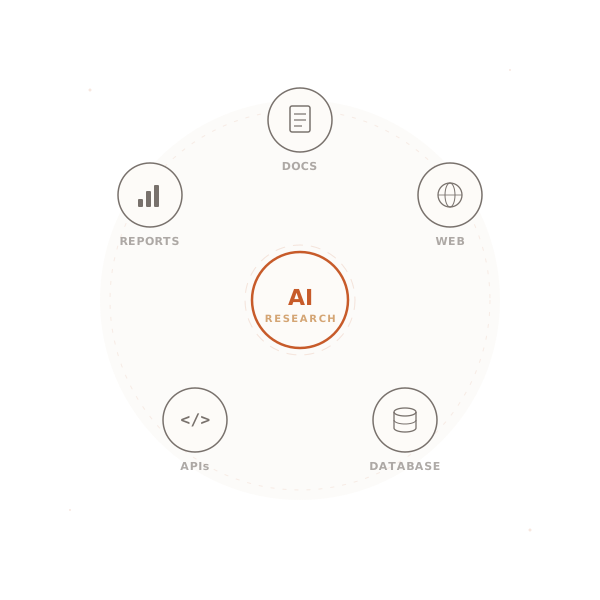
A multi-agent system built on LangGraph, Claude Sonnet 4.5, and Tavily Search coordinates specialist research agents. An orchestrator decomposes the research question into parallel sub-tasks, each handled by a specialist: a news agent running Tavily and Bing News, a filings agent pulling SEC EDGAR and S&P Capital IQ, a company web agent with Playwright, a database agent for licensed sources (Pitchbook, CB Insights), and an internal knowledge agent for your CRM and prior deal notes. A synthesis agent combines findings, resolves contradictions, and produces a structured report with citations. Every factual claim links to its source. Reports deliver as a structured doc, a slide-ready brief, or a data record that feeds into your deal management platform. Research runs on demand or on schedule for ongoing monitoring.
How We Do It
Research Task Decomposition
Given a research request (e.g. 'prepare a full competitive landscape and market sizing for TargetCo in the mid-market HR tech space'), the orchestrator decomposes into sub-tasks: company profile, product landscape, top 5 competitors with comparison, market size estimates from at least two sources, recent funding activity, customer segmentation, leadership background checks, and internal CRM check for prior contact. Each sub-task is assigned to the specialist best suited. The orchestrator tracks dependency (market sizing should complete after competitor identification). Failure mode: the research request is ambiguous ('do research on TargetCo'). The orchestrator asks clarifying questions or applies a sensible default template depending on context.
Parallel Data Gathering
Specialist agents execute in parallel with rate-limited, error-handled API calls. The news agent pulls the last 12 months of coverage and filters for material events (funding, M&A, leadership changes, product launches). The filings agent fetches 10-Ks and 10-Qs via SEC EDGAR if public and S-1s if recently IPO'd. The company web agent walks the target's website and key competitors' websites with Playwright, extracting product descriptions, pricing where disclosed, and customer logos. The database agent queries your licensed data providers. Each agent returns structured findings with per-claim source URLs. Failure mode: a source is rate-limiting or the API is down. The agent retries with backoff and surfaces a 'partial data' flag rather than silently dropping the source.
Synthesis and Fact Verification
A synthesis agent combines findings from all specialists. It resolves contradictions (e.g. two sources cite different employee counts) by comparing recency and source authority, and presents the reconciled figure with alternatives in a footnote. Every factual claim in the output is traceable to a specific retrieved source; claims without source support are flagged rather than included. The agent runs a verification pass that checks key numbers against a second source when possible. Failure mode: only one source supports a claim and the claim is material. The agent marks it 'single-source' with the source cited, rather than asserting as consensus.
Structured Report Delivery
The finished report generates in the requested format: a structured document (Word or Google Docs) for analysts, a 1-page brief for executives, a slide deck for IC meetings, or structured records posted to a deal management platform (DealCloud, Affinity, Salesforce). Templates per audience are defined during setup. Scheduled research (e.g. weekly monitoring of 30 portfolio companies' competitors) delivers automatically to a distribution list. Failure mode: a particular delivery channel fails (email bounces, Slack channel archived). The orchestrator retries alternative channels before flagging to the owner rather than silently failing to deliver.
What You Get
Where this fits — and where it doesn't
Good fit when
- ✓Research patterns that recur frequently (competitive briefs, account intel, market sizing, industry monitoring) and follow a reasonably consistent structure. The agent learns the structure and produces better briefs over time.
- ✓Teams with access to licensed data sources (Capital IQ, Pitchbook, CB Insights, Bloomberg) that can be wired in. The agent's coverage is bounded by what it can legally access, and licensed sources add signal public search can't.
- ✓Organizations where research velocity matters: deal teams, sales teams, strategy teams, investment analysts. If a brief 2 days faster changes the decision, the ROI is obvious.
Not a fit when
- ×Questions that require primary research (customer interviews, supplier conversations, in-person site visits). The agent can't replace human intelligence gathering, only desk research. Use it as a prep layer before primary research, not instead of it.
- ×Highly specialized technical due diligence (code review, architecture assessment, scientific IP evaluation) where the expertise is itself what you're buying. The agent can gather public-domain signals but can't produce the expert judgment.
- ×Research subjects with sparse public footprints: stealth-mode startups, small regional operators, private companies with minimal press coverage. The agent finds less than you'd hope, and a human researcher's network can outperform.
Technology Stack
Integrates with
Industries We Serve
Frequently Asked Questions
How do you ensure the research AI is citing reliable sources, not hallucinating facts?+
Can the system access paywalled databases or internal proprietary data?+
How do you handle research questions that require judgment, not just data gathering?+
Can research reports be customized for different audiences?+
How does the agent handle edge cases it hasn't seen before?+
What happens when the agent is wrong?+
How do we audit every decision?+
How long to production?+
Related reading
The Dyyota AI Maturity Model: Where Does Your Organization Stand?
A 5-level framework to assess your organization's AI maturity. From ad-hoc experiments to production-scale AI operations.
Do You Need a Chief AI Officer? (Probably Not Yet)
Everyone is hiring Chief AI Officers. Most companies do not need one yet. Here is when a CAIO makes sense, when it does not, and what the alternatives cost.
In-House AI Team vs Consulting Firm: The Honest Comparison
Hiring full-time AI engineers or engaging a consulting firm? Real costs, timelines, and risk for each model so you can pick the one that fits.
Ready to build this for your team?
We take this from concept to production deployment. Usually in 3–6 weeks.
Start Your Project →