Grounding (AI)
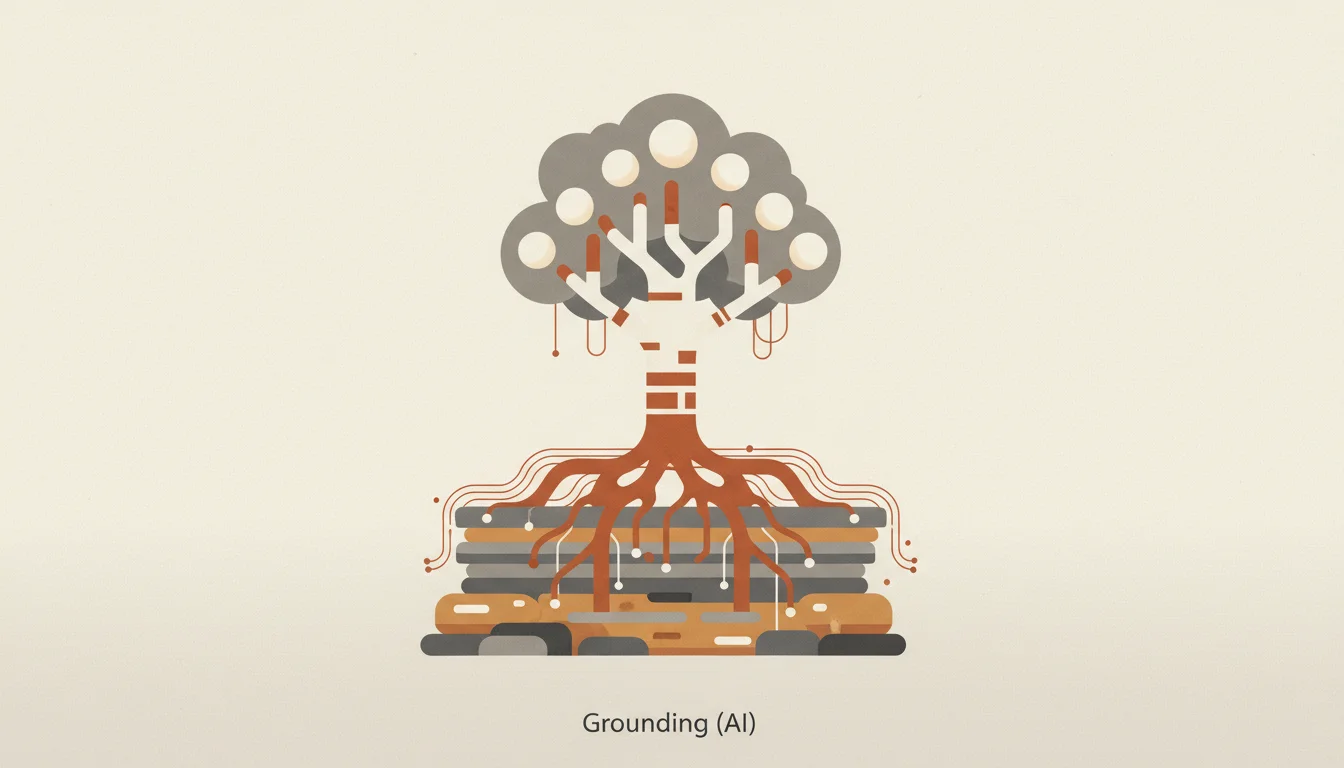
Grounding is the practice of connecting an AI model's outputs to verified, factual source data rather than letting it rely solely on its training knowledge. It ensures that generated responses are based on real documents, databases, or other authoritative sources.
How It Works
A language model trained on internet data has broad knowledge but no way to distinguish its accurate knowledge from its inaccurate knowledge. Grounding gives the model a factual anchor. Instead of generating from memory, it generates from sources you provide.
The most common grounding technique is RAG. You retrieve relevant documents and include them in the prompt, then instruct the model to answer only based on those documents. This turns the model from a knowledge source into a reasoning engine that works with your data.
But grounding goes beyond just retrieval. It also includes verification. After the model generates a response, you can check whether the claims in the response actually appear in the source documents. This is sometimes called attribution or citation verification. If the model says "Our return policy allows 30-day returns," you check that this claim exists in the retrieved policy document.
Enterprise grounding often involves multiple layers. The first layer retrieves relevant context. The second layer instructs the model to cite its sources, often by including span IDs or passage numbers in the prompt and requiring the model to reference them. The third layer programmatically verifies those citations, typically with a smaller model or an NLI (natural language inference) classifier that scores each claim against the cited passage. The fourth layer flags ungrounded claims for human review or rejection.
Well-grounded AI systems are more trustworthy and auditable. When every claim can be traced back to a source document, you can explain why the system said what it said. This matters for compliance, customer trust, and internal confidence in the AI system.
Grounding has limits. It works when the answer exists in your sources. It fails when the user asks something your corpus doesn't cover, which is when models drift back to their training knowledge and start hallucinating. The cure is less about the model and more about the prompt design: instruct the model to say "I don't have information on that" when the retrieved context doesn't support an answer. Measure refusal rate in production as carefully as you measure accuracy. A model that answers everything is hiding hallucinations behind confidence.
In Practice
The grounding stack in production RAG systems typically uses LangChain or LlamaIndex for the retrieval layer, plus a citation-verification pass. Common verification approaches: an NLI classifier (DeBERTa v3 fine-tuned on FEVER, or a hosted API like Vectara's HHEM), an LLM-as-judge pattern using Claude Haiku or GPT-4o mini to check whether each claim follows from cited passages, or a hybrid that runs the cheap NLI first and escalates ambiguous cases to the LLM judge.
Prompt patterns: wrap retrieved passages in XML tags with span IDs, require the model to output claims with inline citations like [span-3], and validate after generation that each citation references a real span and that the claim is entailed by that span. Typical thresholds: entailment probability over 0.75 passes, between 0.5 and 0.75 triggers a re-check with a stronger model or escalation, and below 0.5 the claim is stripped or the whole response is regenerated.
A working workflow. Ingest documents with span IDs preserved. At query time, retrieve top-k passages and number them. Prompt Claude Sonnet with instructions like "answer only using the numbered passages and cite each claim." Parse citations from the response. Run an NLI check on every claim-citation pair. Reject the response and retry if any claim fails verification, or return the claim with a warning marker to the user. Log entailment scores to observability for drift detection.
Worked Example
A commercial insurance underwriter uses an AI assistant to answer coverage questions for broker partners. A broker asks, "Does the small-business property policy cover food spoilage from power outages under 12 hours?" The assistant retrieves the top 5 passages from the current policy PDF and forms guide.
Claude Sonnet is prompted to answer using only the numbered passages with inline citations. It responds: "Food spoilage from power outages is covered if the outage is caused by a covered peril [passage-2]. Coverage requires the outage to last more than 12 continuous hours [passage-4]. So outages under 12 hours are not covered." Three claims, three citations.
A post-processor runs a DeBERTa NLI classifier on each claim against the cited passage. Claim 1 and claim 2 score 0.91 and 0.87 entailment, which pass. Claim 3 is a logical deduction from claims 1 and 2 rather than a direct quote, and scores 0.62. The orchestration layer flags claim 3 as "inferred" and the response goes back to the broker with a visible note: "Based on passages 2 and 4, outages under 12 hours appear not to be covered. Confirm with your policy specialist." The broker has a verifiable answer with clear provenance and a built-in check for the logical leap the model made.
What People Get Wrong
Myth
RAG and grounding are the same thing.
Reality
RAG is one way to ground a model. Grounding is the broader goal: making outputs traceable to verified sources. Grounding can also be done via tool calls to structured databases (where the SQL result is the source), knowledge graphs, or direct API responses. RAG is the most common grounding pattern because it works on unstructured text, but it's not the only one.
Myth
A model that cites sources is automatically grounded.
Reality
Models can cite sources and still hallucinate. They might invent a citation, cite a real source that doesn't actually support the claim, or paraphrase in a way that changes the meaning. Real grounding requires a verification step: programmatically check that each cited passage entails the claim. Without verification, citations are decoration, not proof.
Myth
If you have good grounding, you don't need guardrails.
Reality
Grounding reduces factual hallucination but doesn't handle prompt injection, off-topic requests, toxic outputs, or unauthorized tool use. A grounded AI can still be tricked into answering something it shouldn't, or into following instructions hidden in retrieved documents. Guardrails and grounding cover different risks. Production systems need both.
Related Reading
Need help implementing this?
We build production AI systems for enterprises. Tell us what you are working on and we will scope it in 30 minutes.